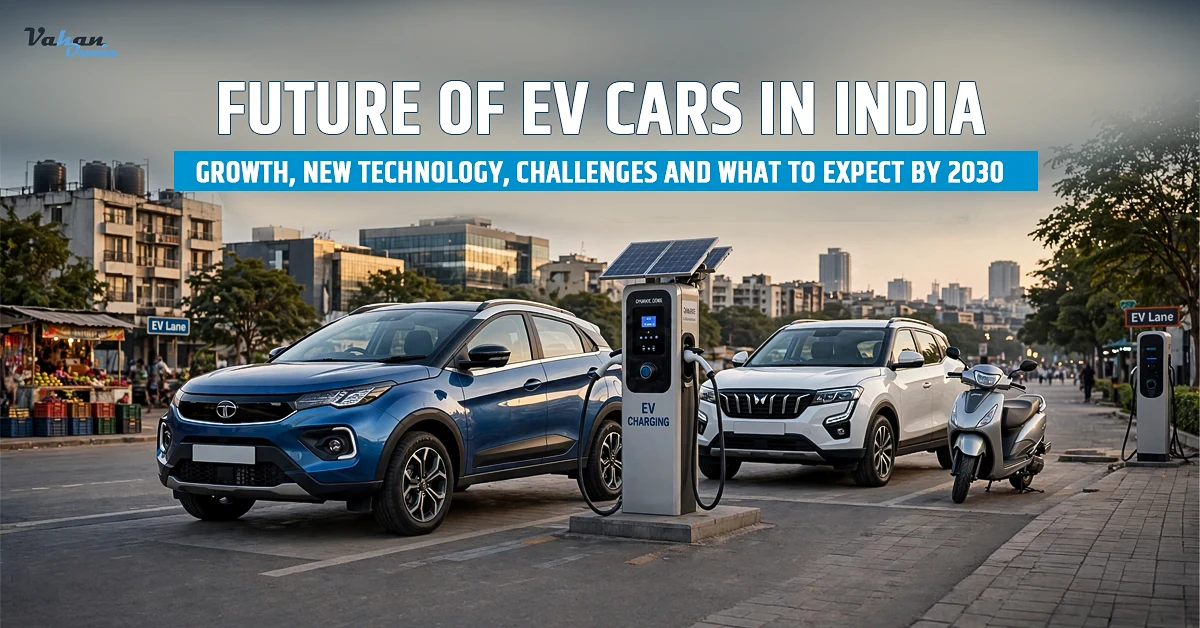
Future of Electric Cars: Expected Growth, Technology, Opportunities and Challenges by 2030
India’s mobility system will likely be characterised by the adoption of EVs. Several reasons, most of which concern consumers, such as higher prices for petrol and diesel, increasing levels of environmental concern, the positive outlook on government policies, and the development of more efficient batteries, will contribute to the mass adoption of electric vehicles in India. Consequently, a number of automakers are introducing a range of electric models in India and are extending their offerings in India.
It is 2026, and India’s EV market is still at its early stage of adoption. Though there is demand for electric two-wheelers and three-wheelers, there is also interest in the adoption of electric passenger cars in the country. Where are we heading with electric passenger cars in India? Will there be more electric passenger cars in India, to the point of replacing conventional cars in India, by 2030? Let’s take a look at the major drivers that are shaping India’s e-mobility.
1. EV Market Growth in India
The Indian market for electric vehicles has significantly developed over the recent past, with customers increasingly recognising the benefits of the technology. Various electric vehicles are available across all price segments.
According to NITI Aayog's assessment, EV market penetration has been estimated to have reached approximately 8.25% in FY 2025-26 from only 0.5% in 2018. Over 8.7 million electric vehicles were in operation on India's roads by the end of FY 2025-26, with an estimated 2.5 million vehicles having been registered in that year.
However, electric passenger cars account for a much smaller proportion of the market compared with two- and three-wheelers, and there is significant growth potential in the Indian electric passenger car market.
India has also set a goal of 30% of electric vehicles by 2030, showing their strong support for cleaner transport.
2. More Affordable Electric Cars Coming Soon
One of the biggest factors influencing EV adoption in India is the initial purchase price. Currently, some electric cars are more expensive than comparable petrol-powered models, mainly because of battery costs.
However, this situation is expected to improve as battery manufacturing expands and automobile companies increase local production.
In the coming years, manufacturers are likely to focus more on affordable electric hatchbacks, compact SUVs and family-friendly EVs. These vehicles could attract middle-class buyers who want lower running costs without compromising on everyday practicality.
Competition between established manufacturers and new EV brands will also encourage companies to offer better features, improved performance and competitive pricing.
3. Battery Technology Will Become More Advanced
Battery technology will play a major role in determining the future of electric cars in India. Currently, lithium-ion batteries are widely used in passenger EVs, but manufacturers and researchers are continuously working on improving battery performance.
Future developments could bring higher energy density, faster charging, improved durability and lower manufacturing costs.
Solid-state batteries are another technology attracting attention globally. They promise improvements in energy density and safety, although large-scale commercial adoption still faces technical and manufacturing challenges.
India is also encouraging domestic advanced chemistry cell manufacturing through production-linked incentive programmes. This could reduce dependence on imported battery cells and strengthen the country's EV manufacturing ecosystem.
4. Charging Infrastructure Will Expand
Charging infrastructure is one of the biggest concerns among potential electric car buyers. Unlike petrol and diesel vehicles, EV owners need access to charging points for regular driving and long-distance journeys.
The government and private companies are investing in public charging infrastructure to address this challenge.
According to the Ministry of Heavy Industries, India had 52,718 public EV charging stations as of July 2026, including 16,561 equipped with fast chargers for cars.
Going forward, charging stations are expected to become more common along highways, at shopping malls, office complexes, residential societies and fuel stations.
Fast-charging technology, improved charger reliability and real-time availability information will make EV ownership more convenient. Home charging solutions will also remain important for customers who have private parking facilities.
5. Government Support Will Accelerate EV Adoption
Government policies will continue to influence India's electric mobility journey. Initiatives such as FAME-II and PM E-DRIVE have supported EV adoption, charging infrastructure and domestic manufacturing.
The PM E-DRIVE scheme, launched in 2024, has an outlay of Rs 11,900 crore and has been extended until March 2028, according to the government's October 2026 update.
It supports selected electric vehicle categories, public charging infrastructure, electric buses and the wider EV manufacturing ecosystem.
Apart from central government initiatives, several Indian states offer additional incentives, road tax benefits and registration-related concessions. These benefits can reduce the overall ownership cost, although the incentives differ depending on the state and vehicle category.
6. Electric SUVs Will Become More Popular
Indian customers have shown a strong preference for SUVs, and this trend is also visible in the electric vehicle segment.
Manufacturers are increasingly introducing electric SUVs with longer driving ranges, spacious cabins, connected technology and advanced safety features.
Companies such as Tata Motors, Mahindra, MG and Hyundai are expected to strengthen their electric portfolios with new models and updated versions.
In the coming years, customers could see more electric SUVs across different price categories, making it easier for families to consider EVs as their primary vehicles.
Improved ground clearance, better battery protection and enhanced highway performance will also be important for Indian driving conditions.
7. Challenges That Could Slow Down EV Growth
Despite the positive outlook, India's electric vehicle industry still faces several challenges.
The first major concern is the higher initial purchase price. Although EVs generally offer lower running costs, the upfront investment can discourage budget-conscious buyers.
Battery replacement costs, resale value and long-term battery health are other important concerns. Customers also want reliable service networks and access to trained technicians.
Charging infrastructure remains unevenly distributed, particularly in smaller cities and rural areas. Long-distance EV travel can become inconvenient when fast chargers are limited or unavailable.
Battery recycling and responsible disposal will also become increasingly important as the number of electric vehicles on Indian roads increases.
Manufacturers and policymakers will need to address these issues to build long-term customer confidence.
8. EV Cars vs Petrol and Diesel Cars: What Does the Future Look Like?
Electric vehicles offer many advantages over vehicles with internal combustion engines, such as the absence of tailpipe emissions, reduced operating costs, and instant torque. As long as electric vehicles have access to convenient and regular charging, as is the case for most customers, they are often a very economical choice.
Petrol and diesel vehicles offer a much longer range and a more established refuelling network, along with a more diverse and affordable range of cars.
Vehicles powered by a hybrid or a compressed natural gas engine, known as a CNG engine, are still likely to be the optimal solution in the next phase of the gradual process of transitioning to sustainable mobility in India.
The widespread adoption of electric cars is likely to take longer than the first wave of adopters, resulting in a combination of powertrains in the market for several years to come.
Final Verdict: What Is the Future of EV Cars in India?
With improvements in technology, a growing network of charging infrastructure, and a raft of new vehicles and supportive government policies, India’s electric car market looks promising and is expected to see a lot of growth.
There are good reasons to believe that by 2030 there will be far more EVs on the road in India. Still, much needs to happen for widespread EV adoption, including lower-cost cars and the deployment of better battery technologies.
After-sales services will also need to improve significantly to better address the needs of car owners.
EVs are already a viable choice for many buyers, particularly for those with the opportunity to charge at home and with high daily commute requirements.
Ultimately, success will be determined by how manufacturers and policymakers choose to address India's challenges, particularly in regard to affordability, the availability of charging infrastructure and confidence in the overall ecosystem.
The next few years are likely to determine the future of mobility in India.