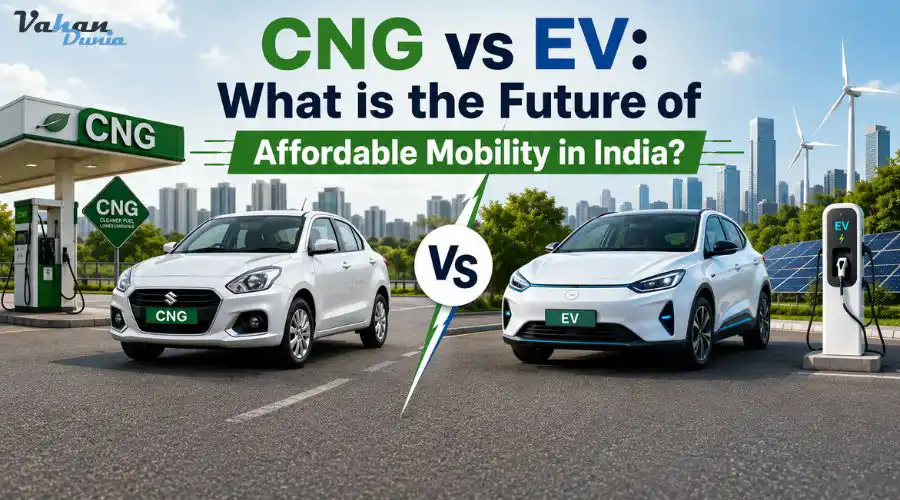
In today's rapidly evolving automotive landscape, the Indian market is transforming to meet the demand for vehicles that are cleaner, more efficient and environmentally friendly. As the cost of fuel keeps rising, emission norms are becoming more stringent and environmental consciousness is growing, many prospective CNG car buyers are now comparing CNG cars and Electric Vehicles (EVs) when they make a buying decision.
These technologies have a number of advantages over traditional petrol and diesel vehicles. But when it comes to affordability, usability and value, the CNG vs EV discussion is rising. Then what is the future for affordable mobility in India? Let's find out.
Why Affordable Mobility Matters in India
The Indian automotive market is among the world's biggest, and price is one of the crucial factors influencing the purchasing decision. Whether you're a commuter, a family car owner or a commercial vehicle operator, drivers want a vehicle that can deliver:
Low running costs
Affordable purchase prices
Easy maintenance
Good resale value
Reliable infrastructure support
The needs these address are different for both CNG and EVs.
An affordable and reliable way to save money is to use CNG Cars.
Compressed Natural Gas (CNG) vehicles have been popular in India for many years. They tend to be especially popular with high-mileage consumers due to their fuel efficiency.
The benefits of CNG Cars include the following:
Slightly lower fuel costs than petrol and diesel.
Generally accessible in large urban areas.
Reduce emissions compared to conventional fuels.
A comparatively low price for an EV.
Successful technology and proven networks.
Challenges for CNG Cars
Space constraint in the boot because of the CNG cylinder.
Less power than petrol variants.
People are waiting in lines to fill up their CNG tanks at the stations.
Inadequate CNG infrastructure in certain parts of rural areas.
Relying on fossil fuels, in particular natural gas.
However, in spite of these hurdles, CNG vehicles are one of the most cost-effective options for those who make long journeys regularly in India.
Future of sustainable mobility: Electric Vehicles
The increased popularity of Electric Vehicles is being driven by government incentives, reduced operating expenses and absence of emissions at the tail end.
Advantages of EVs
Very low operating expenses.
Zero tailpipe emissions.
Smooth and silent driving experience.
Lower maintenance requirements.
Government incentives and subsidies.
Challenges for EVs
A greater up-front expense.
The building of charging infrastructure continues to be in its infancy.
Longer charging times than refueling.
The cost of replacing batteries can be high.
There is no range anxiety when it comes to long journeys.
Many of these challenges are likely to diminish in the years to come as battery technology advances and charging infrastructure grows.
A comparison of the running costs of CNG vs EV
From operating expenses, both CNG and EV vehicles are much more economical than petrol/diesel-powered vehicles.
CNG Running Cost
The running cost of the CNG vehicles is usually approximately between ₹2 and ₹4 per kilometer, depending on the fuel rates and driving conditions.
EV Running Cost
When charged at home, EVs can run on ₹1-2 per kilometer.
Pure running cosstores an area where EVs typically outperform CNG vehicles.
Which Technology is Better Supported: Infrastructure?
CNG Infrastructure
There are thousands of CNG stations already in place in India, in the main cities and on the highways. The government is still pushing its clean energy agenda by adding more CNG stations.
EV Charging Infrastructure
While the number of places for charging EVs is increasing rapidly, it is less widespread than the number of CNG stations. In metro cities, highways, shopping complexes, and residential complexes, charging availability is improving.
Right now, CNG has an infrastructure edge, but there are far more charging infrastructure developments for EVs.
Environmental Impact
Reducing pollution is one of the major drivers of alternative fuels.
CNG Vehicles
Reduced emissions compared to petrol & diesel.
Lower levels of PM emissions.
Cleaner combustion process.
Electric Vehicles
Zero tailpipe emissions.
Decrease urban air pollution.
Potential for renewable energy integration.
In an environmental sense, EVs provide more benefits in the long term, particularly if they are charged with renewable energy.
For everyday commuters, which option is better?
If you are looking to buy a CNG Car:
CNG stations are easily available.
You take a lot of long-distance trips.
You wish to pay less for the car.
Quick refueling convenience is required.
Choose an EV If:
Your main mode of travel is within the city.
Home charging is available.
You are looking for the lowest running costs.
You want to use sustainable forms of transport.
The government's support and prospects. Government support and growth potential.
The government of India is taking steps to encourage the use of CNG and EVs.
For CNG:
Growth of CGD systems.
Increased availability of CNG stations.
Foster the use of cleaner transportation fuels.
For EVs:
Various electric mobility schemes' incentives.
Charging infrastructure investments.
Promote the development of the domestic battery industry.
Encouragement of alternative methods of transportation.
Both of the technologies are getting support, but with India's drive towards carbon reduction, EVs will likely see more policy support in the long run.
What's Next?
CNG and EVs are likely to become key players in India's mobility in the coming decade.
CNG vehicles are expected to continue to be a viable option for those who want to buy or own them, commercial vehicles, taxis and frequent long-distance drivers who need longer driving ranges and faster refuel speeds.
The Electric Vehicles are projected to grow at a faster pace because of technological advancements, cost reduction of batteries, and growth in charging infrastructure. Once the cost of EVs becomes more affordable, they could gradually be the preferred choice for urban mobility.
Final Verdict
It's not a competition of CNG vs EV. It's not a contest between CNG and EV. These two techs are designed for different customers and will coexist for a few years as they are both needed.
However, if costs, availability of infrastructure and distance are important, then CNG is still a great choice. But, for those who want the best of sustainable mobility in terms of low operating expenses and environmental friendliness, EVs can be a huge boon.
The future of affordable mobility in India seems to be a mix of both CNG and Electric Vehicles, making it easier for consumers to select what is best for them, depending on their budget, driving style and lifestyle needs.