Is E20 Petrol Safe for Your Car? Know the Impact on Your Engine
With the country now aiming to transition to higher ethanol blending in petrol, E20 petrol has emerged as an important issue for Indian car owners. Ethanol-blended fuel is a means to reduce reliance on imported crude oil and to decrease some emissions, but many motorists worry about what it does to their cars.
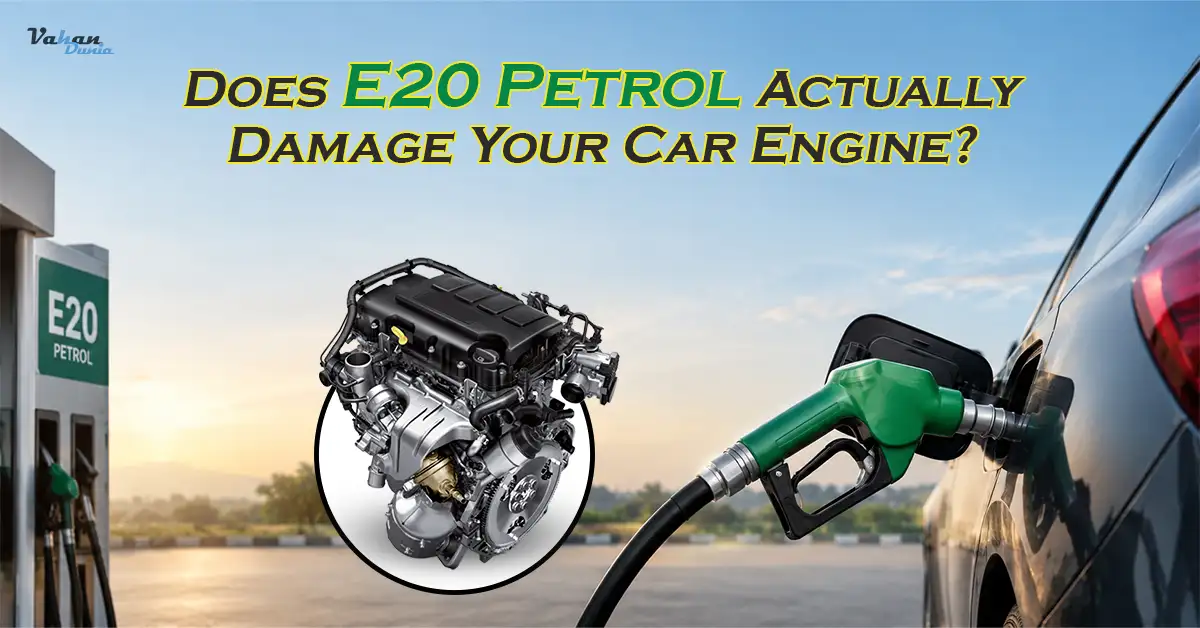
The easiest question to ask is one we all must ask – Does E20 petrol really harm the car engine?
The answer is sort of: yes, it does. Cars designed and tuned for E20 petrol are usually made for fueling with E20. Older vehicles, however, that were built to operate with lower ethanol blends may have decreased fuel economy, material compatibility, and long-term durability of components.
What Is E20 Petrol?
E20 petrol is a petrol fuel that contains up to 20% ethanol. Ethanol is an alcohol-based renewable fuel that can be generated from crops or biological materials.
India has ramped up ethanol blending in petrol, a move it aims to take to cut dependence on crude oil imports and encourage the use of alternative fuels. In the past, most unleaded petrol had a relatively low ethanol content (E5 or E10), and E20 indicates a higher concentration.
But for car owners, E20 is not a totally different fuel. It's a gasoline that has a higher percentage of ethanol.
Will E20 Petrol Harm Car Engine?
If a vehicle is designed and certified to run on E20 fuel, the engine-damage problem is generally not serious if it is used as its designers intended.
Some automakers have been modifying parts of their fuel systems, engine calibration, and other materials to ensure they are compatible with higher ethanol blends.
But for older vehicles, it may be a different story. Ethanol-fuelled vehicles with lower ethanol concentration may not feature all fuel system components that are optimised for long-term use with higher ethanol concentrations.
There may be potential for degradation of some rubber, plastic or metal parts, especially within fuel systems that are more than 10 years old. With respect to fuel-system material compatibility, ethanol will absorb water.
Doing so won't necessarily kill the older car's engine. No engine damage is guaranteed with E20. The effect varies based on the vehicle, its age, fuel system design, and the manufacturer's specifications.
Will E20 Save Fuel?
This is a place where many motorists may detect a difference.
Petrol has more energy per litre than ethanol. This means that one litre of E20 may have a slightly lower energy content than one litre of petrol that is less rich in ethanol content.
This means that under otherwise equal conditions, an E20 car can get slightly worse fuel economy than the same car on a lower ethanol blend of petrol.
The actual difference in real-world mileage will vary depending on factors such as engine efficiency, driving conditions, traffic, tyre pressure, vehicle load, and driving style.
Therefore, if the mileage drops slightly after switching to E20 fuel, this doesn't automatically mean that the engine is being damaged.
What About Older Cars?
Older vehicles need more maintenance.
If your vehicle was built before E20 compatibility became standard, it's best to consult your owner's manual or the manufacturer's official advice to decide on the type of ethanol blend to use.
Older petrol cars might be able to run on E10 but not be optimised for E20. If this does occur, however, there is a potential for wear and/or damage to some fuel system parts to occur over time with continued use of higher ethanol blends.
This should NOT, however, be interpreted as sudden engine failure.
Owners of older cars should determine fuel compatibility, not take an owner's word for it that E20 is totally safe or completely dangerous.
Do Fuel-System Components Get Affected by E20?
Fuel system parts include fuel lines, seals, hoses, fuel injectors, and the fuel tank. Thus, ethanol compatibility becomes a concern.
Higher ethanol concentration can have different effects on materials compared with conventional petrol. Ethanol is also hygroscopic, which means it is able to absorb water from the atmosphere.
Modern E20-compatible vehicles are built using suitable materials and calibration to cope with such situations.
Older cars might employ parts designed for lower ethanol levels. If not, there could be a long period of deterioration.
That's one of the reasons why automakers have been redesigning their cars as they're blending more ethanol.
So Is E20 Petrol Bad for Your Car?
To say that E20 petrol is "bad" for all cars would be an overstatement.
For a vehicle that is E20-compatible, the fuel is a part of the vehicle's design feature. Companies build and adjust compatible engines and fuel systems to operate with the increased ethanol content. Companies develop and fine-tune compatible engines and fuel systems to function with the extra ethanol.
However, if the car is not built to handle E20, there may be issues concerning mileage, the materials used in the fuel system, and long-term durability.
So compatibility of vehicles is the most important issue, rather than just ethanol.
How to Protect Your Car?
There are a few easy things that car owners can do to minimise potential problems.
To start, consult your owner's manual for the recommended ethanol blend. If your manufacturer has given specific instructions for your model, follow them.
Second, maintain your car in good condition. Maintaining vehicle performance may be helped by regular servicing, timely replacement of worn fuel system parts, and choosing fuel from reputable fuel stations.
Changes in mileage, engine performance, starting, and fuel system-related problems should also be monitored.
Owners should not assume the fuel has damaged the engine and should get the vehicle checked out if it starts to exhibit unusual symptoms after E20 has been available to the public.
In a Nutshell: Do You Have to Be Afraid of E20?
A specific design and certification for a car to use E20 petrol is unlikely to ensure that it will not be an engine-damage issue. The real problem is that it won't work on older cars. These vehicles may have variations in fuel economy or, in the long run, problems with components of the fuel system that were not developed to use higher ethanol blends. The first and most crucial step for car owners is to find out if the vehicle is E20 compatible before assuming the fuel is compatible.